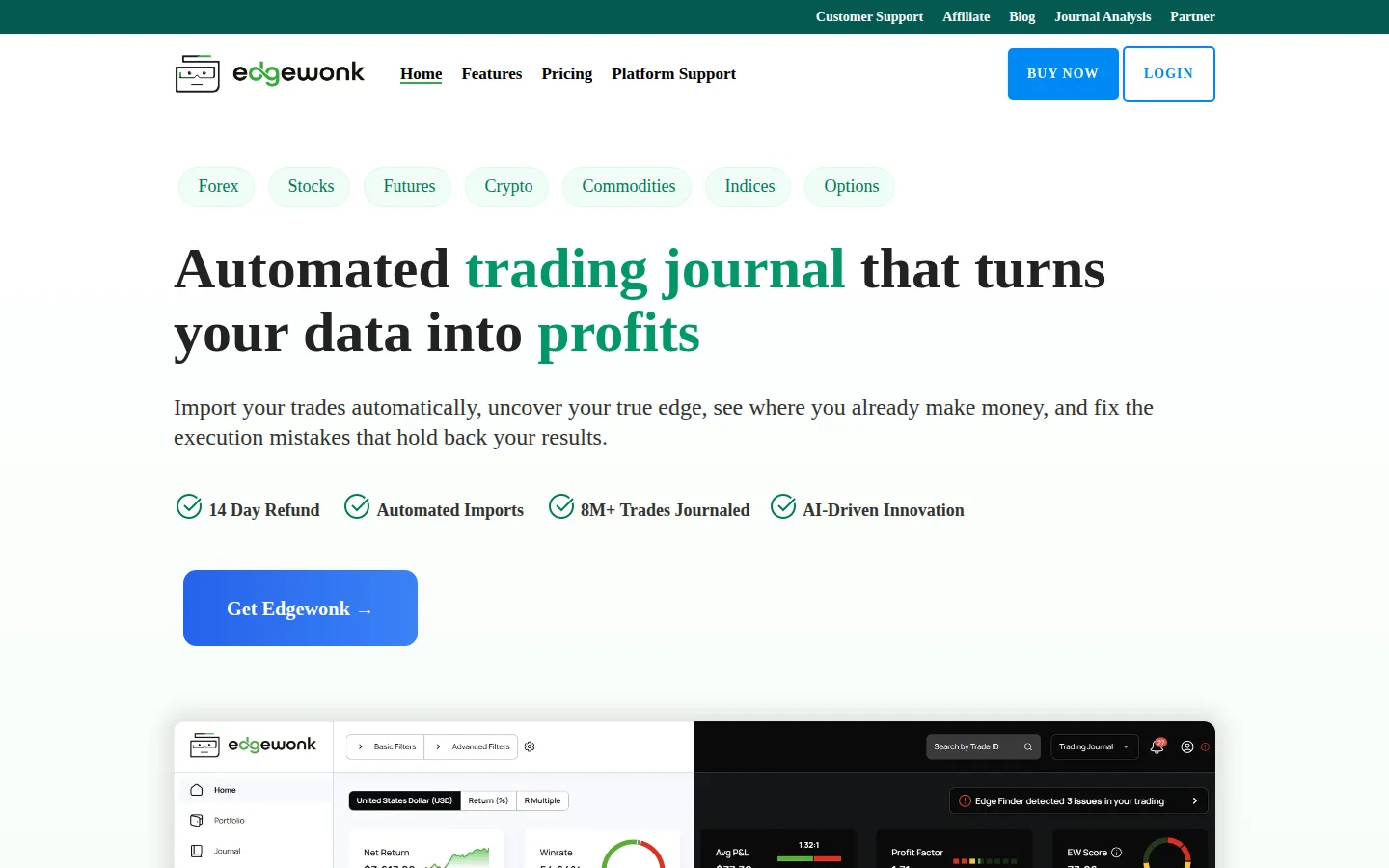
Edgewonk is best for traders who want to diagnose behavior and strategy from their own trade history, not for traders looking for signals or automated execution. Its differentiator is the connection between performance statistics, setup tags, mistakes, checklists and trading psychology. The current product also includes automated analysis and the weekly Edge Finder, so older descriptions of Edgewonk as having “no AI analysis” are no longer accurate.
This review was checked against Edgewonk’s official pricing, feature, import and product pages on July 18, 2026. Edgewonk currently promotes a time-limited bonus period and its pricing page contains two different headline amounts, so checkout should be treated as the final price source.
Start with the problem Edgewonk actually solves
A trading journal becomes useful when it changes a decision. Edgewonk is designed to answer questions such as: Which setup makes money after commissions? Which mistake costs the most? Does following the checklist improve expectancy? At what time of day does performance deteriorate? Are exits cutting profitable trades too early?
That makes it a strong fit for a discretionary or systematic trader who already has trades to analyze and is willing to tag them consistently. It is less useful for a complete beginner with a tiny sample, or for someone who expects the software to create a profitable strategy without disciplined data entry.
The journal supports forex, stocks, futures, crypto, indices, commodities and options. Multiple journals can separate strategies, brokers, prop-firm accounts or live and simulated trading, while the Portfolio view aggregates performance across journals.
Pricing is one full-access subscription, but the current page conflicts
Edgewonk sells one feature-complete subscription rather than several upgrade tiers. The detailed pricing card currently shows $197 billed every 16 months—described as a one-year plan plus four free months, or $12.32 per month over that period. VAT may be added at checkout. The same page also contains a headline telling visitors to “invest $169 today.” Those two amounts do not agree.
Because the offer can change, verify the billed total and renewal period on the final checkout screen. Do not compare the promotional monthly equivalent with a competitor’s true month-to-month subscription: Edgewonk bills the full subscription amount upfront.
There is no conventional free trial. Edgewonk instead offers a 14-day money-back guarantee. That means the customer pays first and must request a refund within the stated period if the product is unsuitable. The current terms and included access are on Edgewonk’s official pricing page.
Import quality determines whether the analytics mean anything
Edgewonk supports fast imports from more than 200 brokers, platforms and prop firms. Its published list includes MetaTrader 4/5, Interactive Brokers, NinjaTrader, Tradovate, Sierra Chart, TradeStation, Charles Schwab, Webull, CQG and TopstepX, among many others. Unsupported platforms can use manual entry or bulk Excel import.
“Supported” does not always mean a live API connection. Import methods vary by platform. MetaTrader can use automated FTP syncing, while other sources may rely on exported files. Before purchasing, find the exact broker and platform—not merely the asset class—on Edgewonk’s supported-import list.
Timezone accuracy matters. A broker timestamp that is shifted relative to local time can corrupt hour-of-day analysis and chart placement. Edgewonk now provides import-timezone settings, but existing journals may require a one-time adjustment. Traders should reconcile a small sample against broker statements before trusting the full dashboard.
Edge Finder changes the old “no AI” verdict
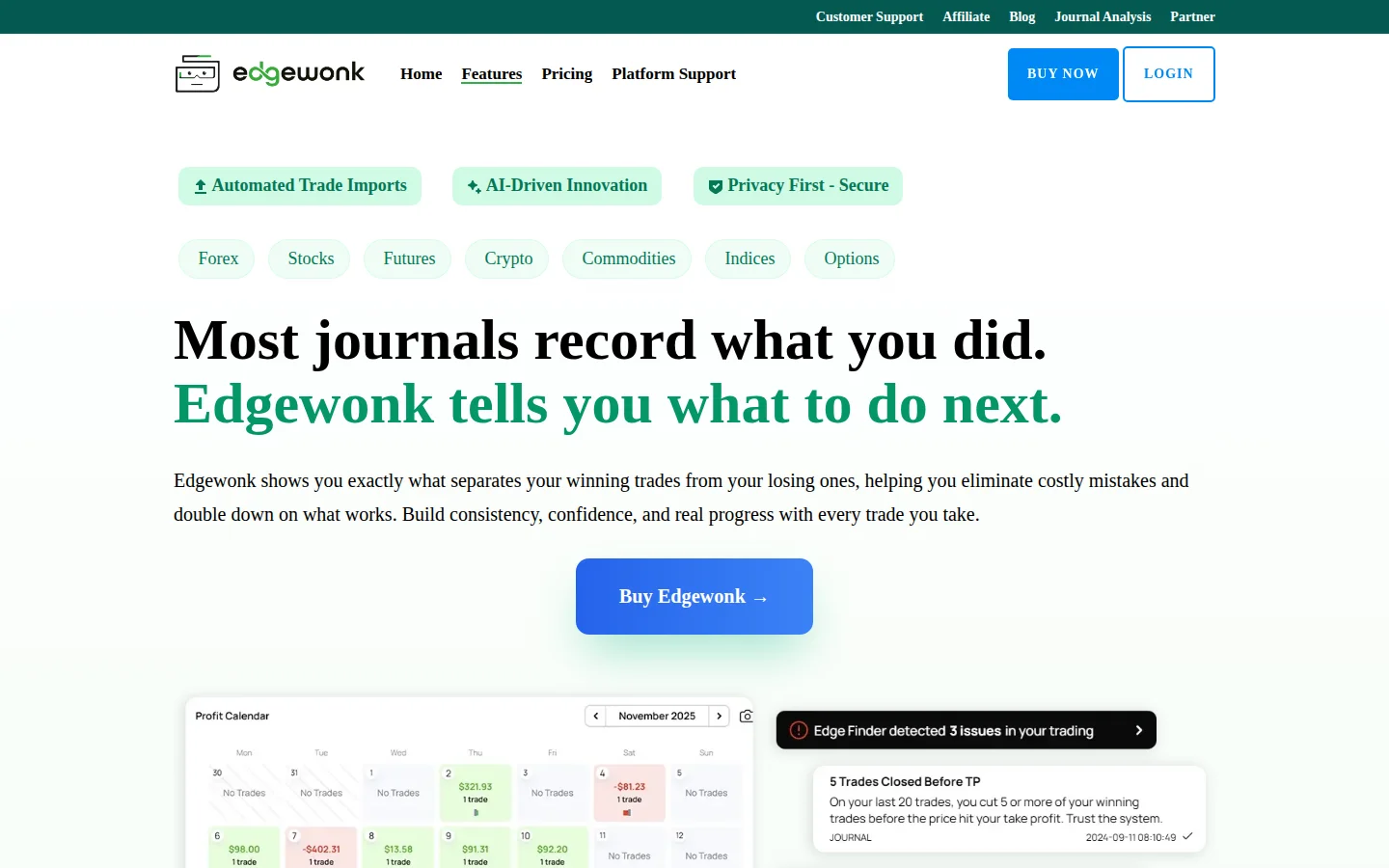
Edge Finder automatically reviews journal data each week, searches across hundreds of data points and highlights strengths, weaknesses and improvement opportunities. Edgewonk describes it as AI-augmented analysis. The platform also provides real-time automated notifications tied to trading behavior and performance.
This is not the same as a conversational coach that understands every market context, and it should not be treated as independent proof that a pattern will persist. It is an automated pattern-discovery layer over the data the trader supplies. Bad tags, mixed strategies, missing commissions or a small sample can produce confident-looking but weak conclusions.
The practical benefit is prioritization. Instead of browsing every report, the trader receives a narrower list of patterns to investigate. Edgewonk’s Edge Finder explanation shows the current automated workflow.
Psychology tracking is useful only when it is defined consistently
Edgewonk links qualitative inputs—mistakes, emotions, discipline and checklist completion—to P&L and expectancy. This is more useful than a standalone diary because it can quantify whether a recurring behavior is associated with worse outcomes.
The danger is retrospective labeling. If “fear,” “FOMO” or “revenge trade” means something different each week, the resulting report is not reliable. Define each tag before using it, keep the tag set small, and record it immediately after the trade. Checklists work best when their items are observable: “entry above VWAP” is more consistent than “setup looked strong.”
Use the first month to establish clean definitions rather than hunting for a dramatic insight. The value of Edgewonk grows with consistent history; it cannot repair inconsistent source data automatically.
Trade Simulator tests rule changes against your own history
The Trade Simulator can model changes to stops, targets and trade-management rules using recorded trades. This is valuable because it asks whether a proposed change would have improved the trader’s actual sample rather than a generic market dataset.
Simulation results remain hypothetical. A rule optimized on the same trades used to discover it can be overfit. Split the history into a discovery sample and an unseen validation sample, then forward-test the change before increasing risk. Include commissions and slippage where possible.
Phone access exists even without relying on a native app
Edgewonk is cloud-based and its current site says the journal can be accessed on phone, tablet and computer. That corrects the impression that traders cannot review it away from a desktop. Buyers who specifically need native iOS or Android features—offline access, mobile notifications or app-store distribution—should test the browser workflow during the refund period rather than assuming cloud access is equivalent to a dedicated app.
The web model has a practical advantage: the same journal and data are available across devices without maintaining separate local databases. The trade-off is dependence on browser usability and an internet connection.
Privacy claims deserve the same scrutiny as analytics claims
Trading history can reveal strategy logic, account size and behavioral weaknesses. Edgewonk states that customer data is not sold, analyzed to reverse-engineer strategies or accessed without explicit support permission, and says its systems undergo independent penetration testing.
Those are vendor claims, not a substitute for reading current legal terms. Traders should avoid uploading credentials, verify what an import file contains, use a unique password and understand retention/export options before making the journal the only copy of their history.
Edgewonk versus TradeZella and TraderSync
Edgewonk should be shortlisted when psychology, mistake costing, custom tags and deep historical analysis matter more than a highly polished coaching interface. TradeZella often appeals to traders who prioritize presentation, replay and a modern guided workflow. TraderSync may suit users who want different automation and reporting combinations across paid tiers.
The decisive test is not the number of charts. Import the same representative trades, recreate the tags and reports you actually use, then measure how quickly each product answers a real review question. Edgewonk’s single-tier model is attractive when its full toolset fits; it is poor value if the trader will only record entries and exits.
Our current assessment
Edgewonk remains one of the strongest specialist journals for traders who take process analysis seriously. Its psychology tools, checklists, Trade Simulator, Portfolio view and automated Edge Finder create a coherent improvement workflow rather than a simple trade log.
Its weaknesses are the upfront annual-style billing, absence of a pay-later free trial, dependence on clean tagging and imports, and a current pricing page that displays conflicting amounts. The right buyer has enough trades to analyze and a weekly review routine. The wrong buyer wants signals, execution, or instant certainty from a small dataset.